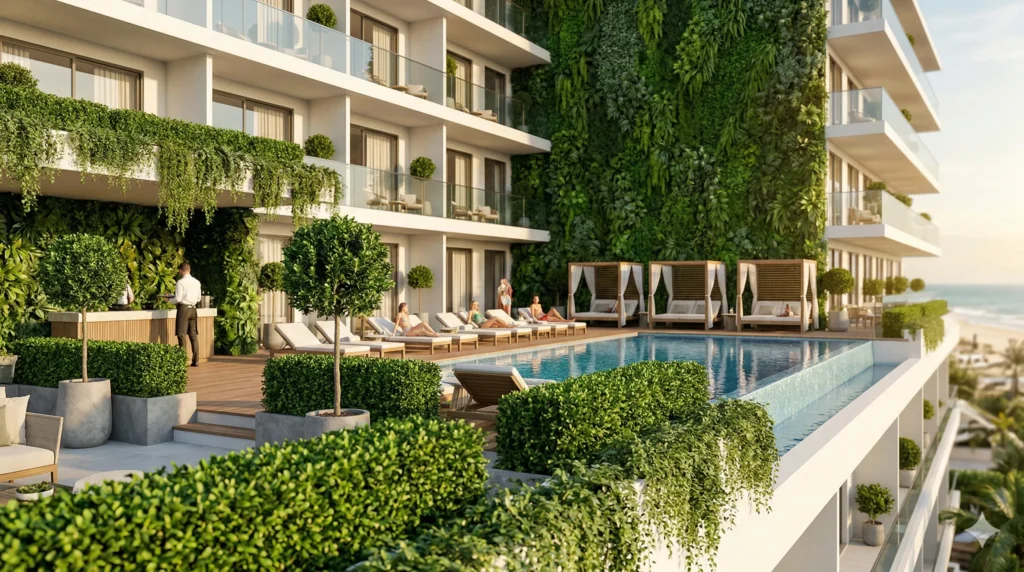
Selecting greenery for outdoor environment is not a simple decorative choice. It directly impacts durability, safety, and cost. Whether you are planning a hotel rooftop in Dubai or a retail storefront in Florida, weather exposure becomes the main challenge.
With more than decades in artificial plant manufacturing, we regularly hear the same concerns from project buyers: “Will these plants withstand strong sun and heavy rain? Are they compliant for public installations?”
The reality is straightforward: faux plants vary significantly in quality. There is a clear difference between decorative-grade and commercial-grade products. In this blog, we explain what to look for before you make a decision.
Are Outdoor Artificial Plants Water-Resistant?
The answer starts at the raw material level.
Most commercial outdoor artificial plants use polyethylene (PE) for the foliage. PE is a non-porous polymer. Water does not absorb into its structure. Rain rolls off PE leaves just as it rolls off a plastic bottle. This is not a coating. It is a fundamental property of the material itself.
The trunk and branch construction matters just as much. At our FeelReal factory, we use fiberglass-reinforced trunks or powder-coated steel armatures for outdoor-rated plants. Both resist rust and structural degradation in wet environments.
The pot or planter is another weak point you may overlook. A waterproof plant in a non-draining, non-sealed pot creates a standing water problem. For outdoor installations, specify planters with drainage holes and UV-stable resin or powder-coated aluminum construction.
Are Outdoor Artificial Plants Fire Retardant?
What “Fire Retardant” Actually Means?
Many buyers assume artificial plants are either fireproof or a fire hazard. Neither extreme is accurate.
Standard plastic plants — the kind sold in home décor stores — use raw PE, PVC, or fabric materials. These are combustible. They will catch fire and contribute to flame spread. In a commercial environment, this creates a serious liability.
Fire retardant fake plants use materials that have been chemically treated or engineered to slow ignition and self-extinguish when a flame source is removed. They will not prevent fire in a catastrophic scenario. But they dramatically reduce the rate of flame propagation — which is exactly what fire safety codes require.
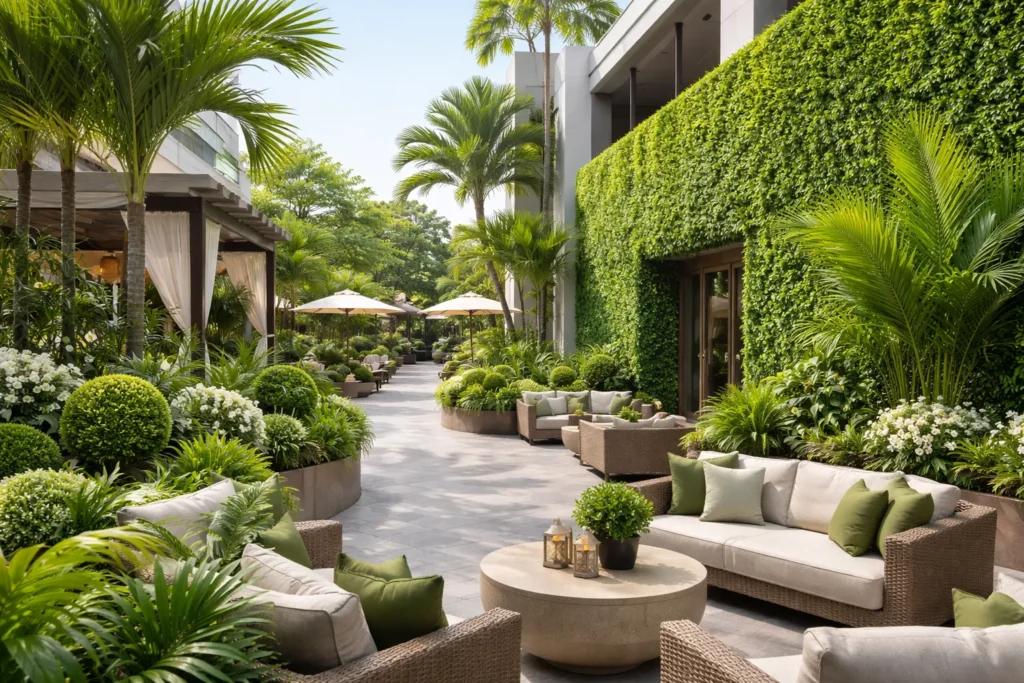
Key International Fire Safety Standards:
When a supplier claims their products are “fire retardant,” ask for the test certificate. Here are the four standards that actually matter:
NFPA 701 — NFPA 701 is widely required in the United States for decorative materials used in commercial interiors. It evaluates flame propagation of textiles and thin plastic films. For artificial plants installed in hotels, shopping malls, and exhibition spaces, compliance with NFPA 701 Method 2 is commonly requested.
EN 13501-1 — The European fire classification standard for construction products. Products are rated from Class A (non-combustible) to Class F (no performance determined). For commercial installations in the EU, artificial plant panels or green walls are often required to meet Class B or Class C ratings, depending on national building regulations.
UL-94 — A Underwriters Laboratories standard focused on the burning behavior of plastic materials. UL-94 evaluates the flammability of plastic materials at the component level. While not a building fire certification, it is often used to verify the flame resistance of plastic resins used in artificial plant manufacturing.
GB 8624 — China’s national fire safety standard. Relevant for projects in mainland China or when sourcing directly from Chinese manufacturers who supply the domestic market. Class B1 is the commercial-grade benchmark.
No single certificate covers all markets. A responsible manufacturer should be able to provide test reports for the standard your target market requires.
UV Resistance: The Third Pillar of Outdoor Durability
Waterproofing keeps the plant structurally sound. Fire retardancy keeps it code-compliant. UV resistance keeps it looking like a real plant — which is the whole point.
How UV Stabilizers Work in Commercial-Grade Products?
Without UV stabilization, PE and polyester materials fade rapidly under direct sunlight. Colors shift from deep green to yellowish or bleached white within 6 to 12 months. This is not a cosmetic issue — a faded installation in a luxury hotel lobby or resort pool deck reflects poorly on the brand image.
UV stabilizers — particularly HALS (Hindered Amine Light Stabilizers) — are compounded directly into the polymer during production. Rather than simply blocking UV light, HALS work by neutralizing free radicals generated during photo-oxidation, effectively interrupting the degradation chain reaction triggered by sunlight. Like IFR additives, they provide the most reliable long-term protection when integrated into the raw material rather than applied as a surface coating.
Related Reading: UV-Protected vs. Non-UV Artificial Plants: What’s the Real Difference?
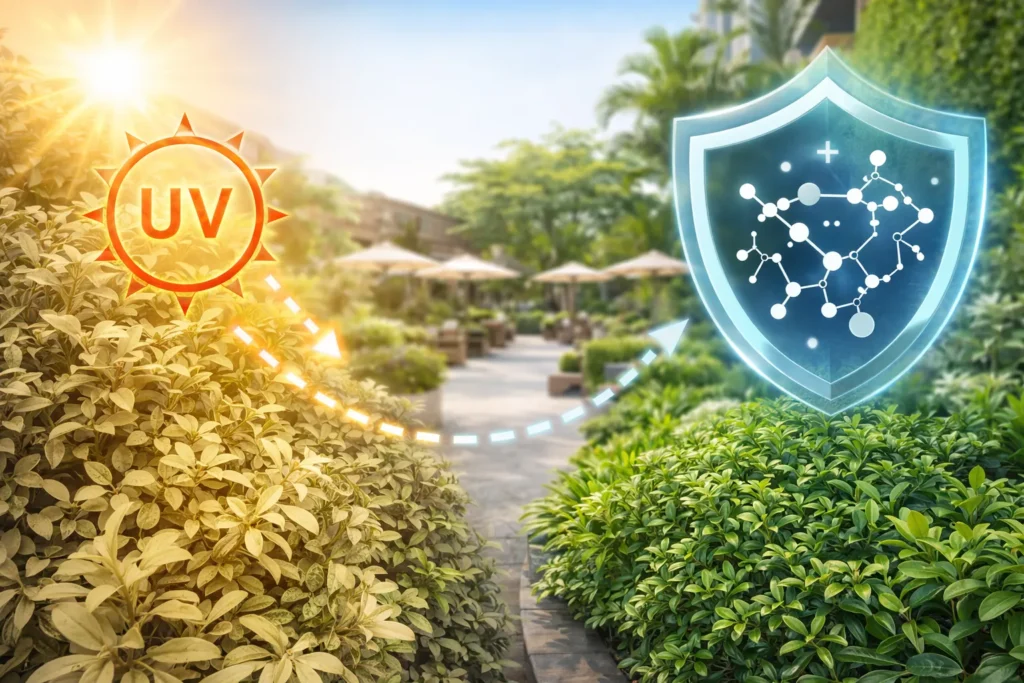
What the ASTM G154 Test Actually Measures
The ASTM G154 standard simulates outdoor weathering using fluorescent UV lamps, moisture cycles, and elevated temperatures. It accelerates the effects of years of sun, humidity, and heat into controlled laboratory hours, primarily assessing photo-oxidative degradation that affects color, gloss, and mechanical integrity.
Industry benchmarks for outdoor artificial plants:
1,000 hours — minimum standard for general outdoor use; indicates no significant color change under controlled conditions
3,000 hours — recommended for high-UV environments such as the Middle East, South Asia, or tropical coastal regions
5,000 hours — premium benchmark for extreme climates or projects requiring long-term color stability
When evaluating UV claims, request a third-party SGS, Intertek, or TÜV report citing ASTM G154 and the specific hour rating. A supplier claiming “UV resistant” without verified test data is making a marketing claim, not a performance guarantee. For long-term outdoor projects, ensure the UV stabilizers are compounded into the material, not just surface-coated.
Waterproof + Fire Retardant + UV Resistant: Do You Need All Three?
For outdoor commercial installations, yes — always.
Here is why each matters by venue type:
| Venue Type | Waterproof | Fire Retardant | UV Resistant |
| Hotel & Resort (Outdoor) | ✅ Essential | ✅ Required by code | ✅ Essential |
| Restaurant Patio / Terrace | ✅ Essential | ✅ Required by code | ✅ Essential |
| Shopping Mall (Exterior) | ✅ Essential | ✅ Required by code | ✅ Essential |
| Theme Park & Entertainment | ✅ Essential | ✅ Required by code | ✅ Essential |
| Indoor Commercial (Lobby, Retail) | ✅ Recommended | ✅ Required by code | ⚠️ Situational |
Most commercial fire codes in the US, EU, UK, Australia, and Middle East require documented fire retardancy for artificial plants in public-facing spaces. Hotel procurement teams and restaurant chains often face inspections. A product without certification documentation creates a compliance gap that falls on the buyer, not the supplier.
Certifications to Demand from Your Supplier
For commercial-grade outdoor artificial plants, a credible manufacturer should be able to provide independent documentation, including:
Fire retardant test report — Depending on your market, this may include NFPA 701 (US), EN 13501-1 (EU), GB 8624 (China), or UL-94 (material-level plastic flame rating).
ASTM G154 UV weathering test report — Conducted by a recognized third-party lab such as SGS, Intertek, or Bureau Veritas, confirming long-term color stability under simulated sunlight exposure.
ISO 9001 certification — Demonstrates a robust quality management system.
BSCI or SMETA audit — Confirms social compliance and ethical manufacturing practices.
RoHS / SGS material safety report — Confirms materials are free from hazardous substances and safe for commercial use.
If a supplier cannot provide these documents, it indicates the product has not been independently verified. In professional commercial procurement, claims without supporting certification should be treated with caution.

FAQ about Outdoor Artificial Plants:
1. Do fire retardant artificial plants look different from regular ones?
No. IFR additives and UV stabilizers are invisible within the material. A well-made fire retardant plant is visually identical to a standard decorative plant.
2. How long do outdoor artificial plants last in direct sunlight?
With proper IFR and UV stabilization, high-quality commercial outdoor plants maintain their appearance for 3 to 5 years in standard climates, and 2 to 3 years in extreme UV environments like the Middle East or tropical coastal zones.
3. Are all outdoor artificial plants waterproof?
No. Many basic artificial plants use silk or low-grade fabrics that absorb water and rot. Professional outdoor plants use high-density polyethylene (PE) and integrated molding. This design keeps moisture out and prevents internal wires from rusting.
4. What does “Inherently Fire Retardant” (IFR) mean?
IFR means we mix fire-retardant chemicals directly into the raw material during production. Unlike surface sprays, IFR protection never washes off or wears out. The plant remains flame-resistant for its entire lifespan.
Choosing a Manufacturer Who Can Prove It
Not all outdoor greenery can withstand the elements. For large-scale projects, you need materials that are engineered. Look for Inherently Fire Retardant (IFR) technology and UV-infused polymers to ensure your project stays green and safe for years.
At our FeelReal factory, we produce commercial-grade artificial plants with built-in UV stabilizers and fire-retardant materials. All products undergo independent testing and certification, ensuring long-lasting durability, color retention, and compliance for demanding outdoor and public-space projects.
Looking for certified outdoor artificial plants for your next commercial project? Contact our team for product specifications, certification documentation, and custom sample requests.